
Best Art for Dark Rooms That Brightens Space
A dark room does not need pale, timid art. It needs a visual spark: a painting that catches the available light, creates a sense of depth, and gives the eye somewhere joyful to land. The best art for dark rooms is often more colorful, more intentional, and more expressive than people expect. Done well, it turns a shadowy living room, hallway, bedroom, or office into a space with atmosphere rather than a space that feels underlit.
The goal is not to fight the darkness with one bright object. It is to create contrast, movement, and warmth that feel natural to the room. A luminous abstract, a richly layered floral, or a faux stained-glass-inspired work can bring life forward from a deep wall or a low-light corner.
What Makes the Best Art for Dark Rooms?
Light conditions change how every artwork is seen. In a bright white room, even a quiet neutral drawing can hold its own. In a room with charcoal walls, limited windows, north-facing light, or heavy furnishings, art needs greater visual presence. Color contrast matters, but so do finish, scale, framing, and where the piece sits in relation to lamps and windows.
Look for work with clear areas of light against dark, saturated color, or a sense of internal glow. Paintings with cobalt, turquoise, emerald, coral, crimson, gold, violet, and vivid white can appear especially striking in low light. These shades do not all need to appear in one piece. A focused palette can be just as powerful when it has enough contrast and texture.
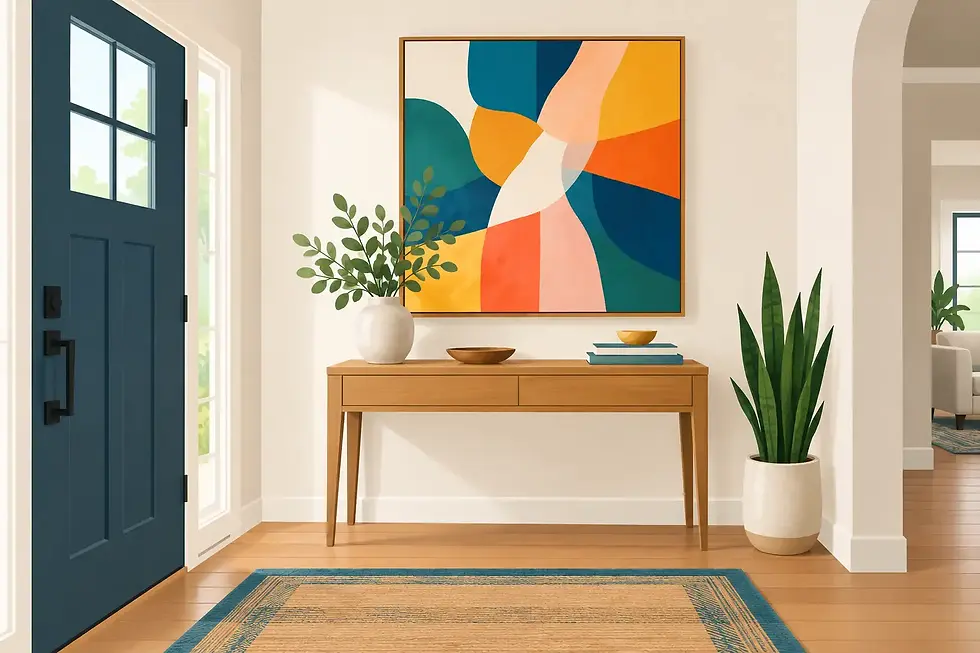
Abstract art is a particularly beautiful choice because it does not depend on tiny details being visible from across the room. Bold shapes, layered washes, energetic lines, and contrasting color fields remain legible in softer light. They also invite a different experience throughout the day, becoming moodier at night and more radiant when daylight returns.
Choose color with a little tension
A common mistake is choosing art that perfectly matches the room's darkest color. A black-and-gray painting on a deep navy wall may be elegant, but it can disappear unless it has bright highlights, metallic accents, or a substantial light frame. Harmony matters, yet a little tension gives a room its energy.
If the room is painted dark green, consider art with aqua, warm pink, saffron, or creamy white. For deep blue walls, artwork with orange, coral, gold, magenta, or electric turquoise can create immediate vitality. In a brown, taupe, or black interior, jewel tones and botanical greens offer a fresh lift without making the space feel overly busy.
That does not mean every dark room needs rainbow color. A black-and-white work can be dramatic when its whites are crisp and generous. A moody marine painting can feel luminous when the water includes layers of blue-green and reflected light. The best choice depends on whether you want the room to feel intimate and cinematic or bright, spirited, and social.
Go Larger Than You Think
Small art tends to recede in a dark room, particularly when it is hung alone on a large wall. This is why scale is one of the most practical decisions you can make. A substantial canvas or a carefully grouped arrangement creates a focal point that keeps the room from feeling heavy.
Above a sofa, bed, credenza, or reception desk, let the artwork span roughly two-thirds to three-quarters of the furniture width. This is not a rigid formula, but it gives the composition enough visual authority. A narrow 12-inch piece over a wide sofa can look lost, while a generously scaled panoramic or statement abstract becomes part of the room's architecture.
For a compact hallway or a dark wall between windows, one vertical artwork can be more effective than several small ones. Its height draws the eye upward and helps the ceiling feel less enclosed. In a stairwell, a series can work beautifully, but keep a consistent palette or framing approach so the collection reads as one intentional gesture.
If an original large painting is beyond the current budget, a high-definition giclée reproduction can offer the same visual impact at a more accessible price. Quality matters here. A richly printed reproduction on archival materials preserves the color depth and detail that a dark room needs, rather than looking flat or faded beside the furnishings.
Use Finish and Texture to Catch the Light
The surface of art matters almost as much as its subject. Smooth, matte work can feel refined, but a low-light room often benefits from textural layers, dimensional brushwork, or areas of translucent color that respond to nearby lighting.
Alcohol inks are especially compelling in darker interiors because they can create pools of vivid pigment, delicate edges, and luminous transitions. Faux stained-glass techniques offer another memorable effect: defined lines and jewel-like color can make the artwork feel illuminated from within. These qualities bring a polished, gallery-style presence to a room without requiring a major renovation.
Be thoughtful with high-gloss glass if the artwork will face a window or a strong lamp. Reflections can obscure the image at night or create glare during the day. In that setting, a canvas, a floated print, or non-glare glazing may be the more enjoyable choice. A subtle sheen is lovely; a mirror-like reflection is rarely the goal.
Frame for contrast, not camouflage
A frame can either give artwork a clear edge or let it melt into the wall. On dark walls, light wood, natural oak, brushed gold, champagne metal, or a slim white frame can provide a beautiful outline. For a dramatic, gallery-inspired effect, a black frame can also work, provided the artwork itself contains enough bright color or a generous white border.
Frameless canvas has its own advantage. It feels immediate and contemporary, especially for expressive abstracts with color that carries over the edges. This approach is ideal when you want the painting to feel less like an object placed on the wall and more like an extension of the room's atmosphere.
Place Art Where It Can Be Seen, Not Just Hung
The right artwork can still underperform when the lighting is wrong. Before committing to placement, observe the wall in morning, afternoon, and evening. Notice where shadows gather and where lamps cast reflections. This simple check prevents a color-rich painting from ending up in the one corner where its brightest passages cannot be appreciated.
Aim for light that washes across the art rather than shining directly into it. An adjustable picture light, a nearby wall sconce, or a directional ceiling fixture can reveal texture and color without glare. Warm-white lighting usually flatters saturated art and makes a dark room feel inviting. Very cool bulbs can make certain blues and whites feel sharp or sterile, although they may suit a modern commercial setting.
Hang the center of a primary piece at approximately eye level, often around 57 to 60 inches from the floor. Over furniture, leave enough breathing room above the surface so the art feels connected but not crowded. In rooms with low ceilings, a vertical work or a taller arrangement can create welcome lift.
For particularly dark spaces, consider using one expressive painting as the visual anchor, then repeat one or two of its colors elsewhere in a pillow, vase, rug, or upholstered chair. This does not have to be a perfect match. A small echo of teal or coral is enough to make the art feel woven into the room.
Subjects That Bring Life to Low-Light Spaces
Colorful abstraction is not the only answer. Floral paintings can soften a dark dining room or bedroom, especially when blooms are rendered in lively pinks, reds, purples, and greens. Jungle-inspired art brings lushness to rooms with dark olive, charcoal, or black walls. Marine scenes can open up a compact office when they include an active horizon or bright, layered water.
Panoramic works are useful where a room needs visual width, while orchids and other elegant botanicals suit spaces that call for calm refinement. The key is choosing a composition with a clear focal area. In lower light, an artwork with a recognizable center of energy - a bloom, a sweep of color, a luminous line, or a horizon - is easier to enjoy than one that is uniformly dark and highly detailed.
At Mila's Creations, vibrant original paintings and museum-quality giclées make it possible to choose that focal point according to both your space and your budget. An original may offer one-of-a-kind texture and presence, while a carefully produced reproduction is a meaningful way to bring expressive color into more than one room.
A dark room asks for art with confidence. Choose the piece that makes you pause from the doorway, then give it enough scale and thoughtful light to do what it was made to do: make the room feel unmistakably yours.


Comments