
Abstract Art Versus Landscape Art for Your Home
A blank wall above a sofa can feel like a question waiting to be answered. Do you want it to open the room toward a misty shoreline, a mountain view, or a sunlit field? Or should it arrive with pure color, movement, and feeling - a piece that makes every guest pause? The choice between abstract art versus landscape art is less about knowing art history and more about deciding how you want a space to feel when you walk into it.
Both styles can be deeply personal, elegant, and visually powerful. Yet they create their impact in different ways. A landscape offers a recognizable place to enter; an abstract painting offers an experience that shifts with your mood, the light, and the life unfolding around it.
Abstract Art Versus Landscape Art: The Essential Difference
Landscape art interprets the visible world. It may portray a quiet lake, a coastal horizon, a forest path, rolling hills, or an expansive city view. Even when the artist uses expressive color or loose brushwork, the viewer can usually recognize a setting. That sense of place often brings immediate calm, nostalgia, or a welcome connection to nature.
Abstract art begins somewhere else. It may be inspired by a memory, a landscape, music, emotion, or the energy of color itself, but it does not need to describe a scene literally. Shapes, layers, gestural marks, texture, and unexpected color relationships become the subject. A vibrant blue may feel like water to one person and confidence to another. A sweeping gold line may suggest sunlight, movement, or celebration.
Neither approach is more sophisticated or more valuable than the other. The better choice depends on whether you want your artwork to tell a clear visual story or leave room for your own story to develop over time.
Choose by the Feeling You Want to Create
The quickest way to choose art is not to ask, “What matches my furniture?” Start with the atmosphere you want to live with.
A landscape is often a natural fit for rooms meant to restore and settle you. A soft marine scene can bring a feeling of air and distance to a bedroom. Green woodland imagery can make an office feel less enclosed. A panoramic vista can visually extend a small dining room, particularly when the composition includes an open sky, shoreline, or receding path.
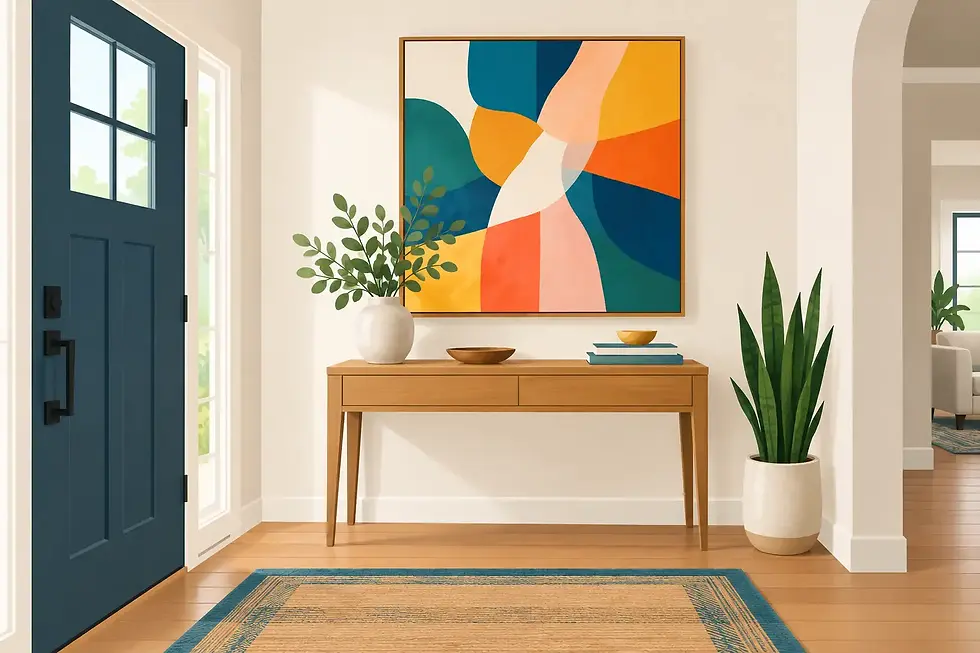
Abstract art can create calm too, but it does so with more flexibility. Gentle washes of blue, cream, and gray can feel meditative. Rich reds, oranges, cobalt, or jewel tones can bring vitality to an entryway or a contemporary living room. A faux stained-glass-inspired composition can scatter visual energy across a wall while retaining the balanced structure that makes a room feel polished.
Consider the difference between a peaceful scene and a powerful mood. If you want a room to whisper, a landscape may speak most naturally. If you want it to feel expressive, confident, and unmistakably yours, abstract art is often the stronger choice.
When a Recognizable View Matters
Landscapes are especially meaningful when a place holds emotional weight. A lake may remind you of family summers. A coastal painting may keep a favorite vacation close. A garden scene may echo a home you loved or a dream of the life you are building.
They also make an easy visual entry point for guests. No explanation is required to appreciate a beach at sunset or an autumn forest. For a shared space where family members have very different tastes, that immediate accessibility can be a real advantage.
When Color Is the Main Character
Abstract work is ideal when you are furnishing around a palette rather than a location. Perhaps your room has warm walnut, creamy upholstery, and brass lighting, but needs a burst of teal, magenta, or amber to feel complete. Perhaps a neutral condo needs one unforgettable focal point. An original abstract painting can carry those colors with depth and intention, rather than simply repeating them.
This is where handmade work offers something especially lasting. Layered paint, mixed techniques, alcohol inks, and textured surfaces react differently as daylight changes. The piece continues to reveal itself, so a wall does not feel finished in a static way. It feels alive.
Think About the Room Before the Subject
A beautiful painting can be wrong for a particular wall, and that is not a failure of the artwork. Scale, viewing distance, lighting, and the surrounding furnishings all shape the result.
For a large wall above a sectional, a single substantial canvas can create a composed, gallery-like anchor. Abstract art often performs beautifully at this size because its color fields and gestures remain compelling from across the room. A broad landscape can work just as well, especially a panoramic composition, but make sure the horizon and visual detail do not disappear behind the scale of the furniture.
In a narrow hallway or over a console, vertical abstract art can add lift and rhythm. A vertical landscape, such as a stand of trees or a cascading shoreline, can create the same effect while adding a sense of depth. For smaller walls, avoid choosing a tiny piece simply because the wall is modest. One well-proportioned work with breathing room around it usually feels more intentional than several undersized pieces.
Lighting matters as much as dimensions. Natural light can make blues, greens, and translucent ink effects glow. In the evening, warm lighting tends to enrich golds, reds, and textured paint. If the wall is in a darker area, choose art with enough contrast or luminosity to remain present after sunset.
Let Your Existing Décor Set the Direction, Not the Rules
Landscape art is often associated with traditional or rustic interiors, but that is far too narrow. A minimal shoreline in a slim frame can feel at home in a modern apartment. A dramatic ocean or mountain scene can balance clean-lined furniture by bringing in an organic counterpoint.
Likewise, abstract art is not reserved for ultra-modern rooms. A color-rich abstract can bring new life to classic furnishings, antique wood, tailored drapery, or a neutral transitional space. The key is visual conversation. Pull one or two colors from the artwork into a pillow, vase, rug, or chair, then let the painting remain the most expressive voice in the room.
Do not feel pressured to match every color exactly. A close relationship is more elegant than a perfect copy. A painting with a hint of coral can warm a room with blush accents; a deep turquoise can complement navy without becoming visually flat. Art should enrich the palette, not behave like a fabric swatch.
Original Paintings and Giclées Offer Different Paths
The style you love is only one part of the decision. Budget, placement, and collecting goals also matter.
An original painting offers the direct presence of the artist's hand. You may see raised texture, subtle variation, layered color, or marks that cannot be reproduced precisely. For a primary living room, reception area, or space where you want a true centerpiece, an original can become part of the identity of the home.
A high-quality giclée reproduction makes expressive artwork more accessible and can be a thoughtful choice for a guest room, hallway, office, or coordinated set of spaces. When produced with archival-quality materials and faithful color, a giclée lets you enjoy an image you love at a price point that supports your decorating plans. It is not about settling. It is about choosing the format that suits the moment and the wall.
A Simple Way to Decide
If you are torn, picture the room after a demanding day. Would you rather look toward a place that lets your mind wander, or toward color and form that renew your energy? That answer is usually more useful than any decorating rule.
Choose landscape art when a sense of nature, memory, escape, or visual depth is what the room needs. Choose abstract art when you want color, individuality, and an emotional presence that cannot be reduced to one interpretation. And if you love both, let your home hold both. A serene landscape in the bedroom and a vibrant abstract in the living area can give each room its own voice while still feeling beautifully connected.
The most rewarding artwork is not the piece that follows a trend. It is the piece that still catches your eye months later, changing the feeling of an ordinary morning and making your space feel more like your own.


Comments